Summary
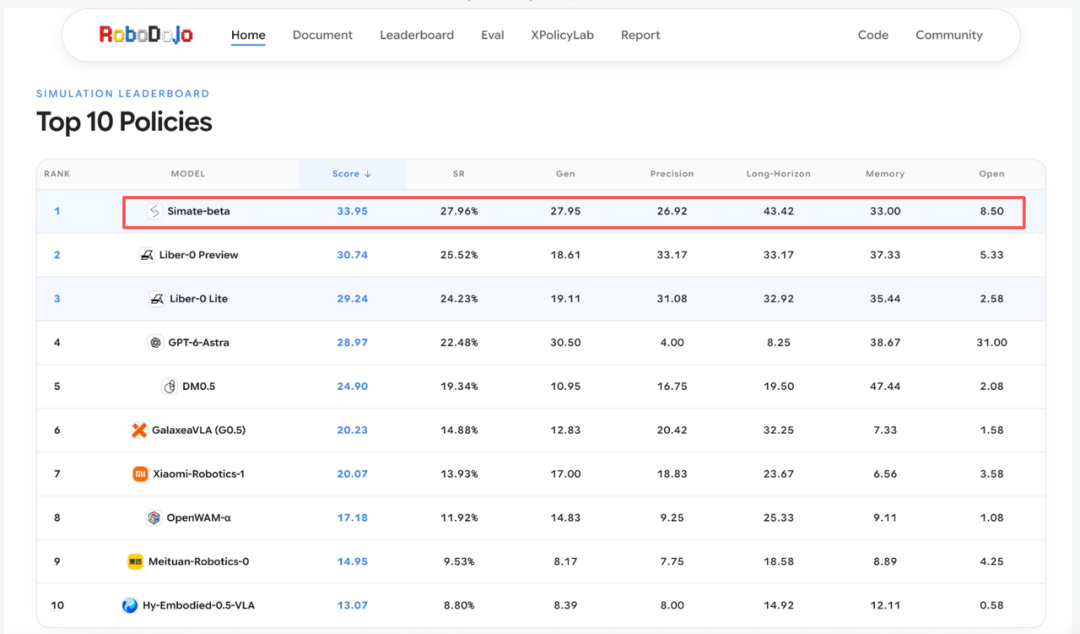
RoboDojo recently published its latest embodied AI rankings. Simate-beta, the general physical fast system from Simate…
RoboDojo recently published its latest embodied AI rankings. Simate-beta, the general physical fast system from Simate, placed first with a score of 33.95 and a success rate of 27.96%. It also demonstrated broad capabilities across Long-Horizon, Memory, Precision, and other dimensions.

Drawing on its long experience in embodied data collection, Xense has built a system spanning collection devices, a data collection toolchain, collection standards, data processing pipelines, and closed-loop model validation. It captures and combines multimodal data, uses stronger physical consistency requirements to govern data quality, and gives models a more complete understanding of tasks. This infrastructure supports Simate's model learning and iteration.
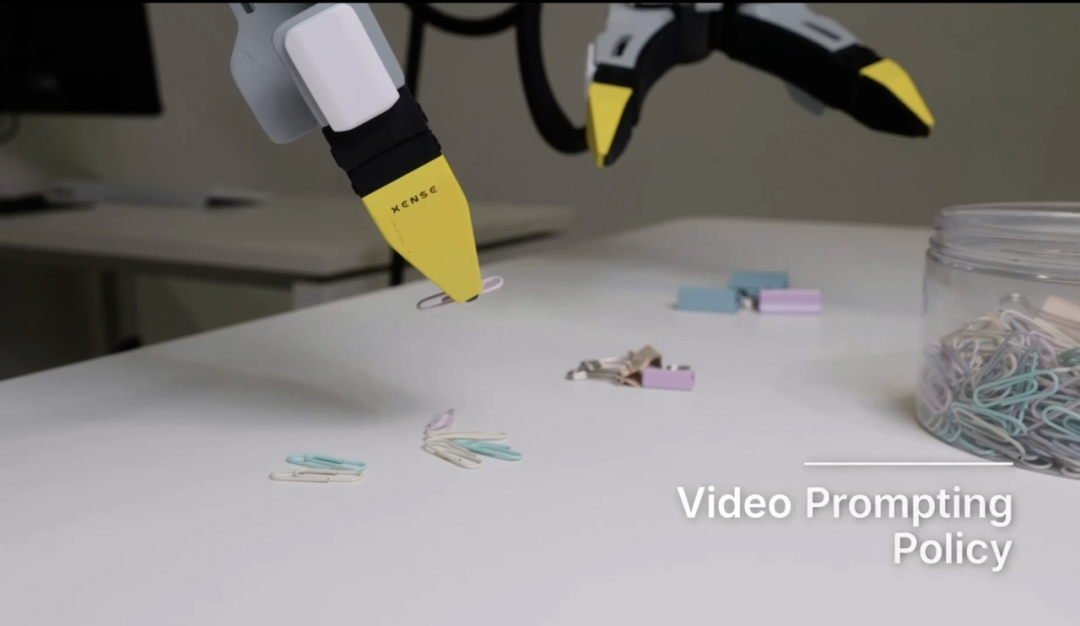
In Simate's public demonstration, the robot grasped and stored tiny objects such as paper clips and binder clips, also showcasing Xense Robotics' capabilities in fine interaction.
01. From a Shortage of Scale to a Shortage of Quality
Embodied AI data has expanded rapidly over the past two years, with evolving collection methods and a growing number of open datasets. A new bottleneck has emerged: although data volumes are rising, models' ability to handle fine interactions has not improved at the same rate. The scarcity of high-quality data has become a central obstacle to improving model performance.
The first dimension of quality is completeness. A real robot operation is more than a final success or failure. Changes in an object's state, the robot's actions, the path of its movements, contact events, and changes in the environment throughout the task are all necessary to understand what happened. Much of this information is tactile. In fine manipulation, the eye often cannot distinguish what the hand can feel. Contact states, force changes, and small adjustments are difficult to capture fully through vision alone.
The second dimension is consistency. Visual, tactile, pose, and action data come from different sensors with different frequencies and coordinate systems. Only when they are synchronized in time, aligned in space, and controlled for quality do they represent the same event in a form a model can use directly. Otherwise, they are raw materials requiring costly post-processing.
The quality and efficiency of data supply now shape how quickly physical intelligence models can improve. That is why Xense built its data collection system.
02. TacVerse Represents Data Standards Models Can Actually Use
Xense has developed high-quality multimodal data standards around capturing real operations in their entirety.
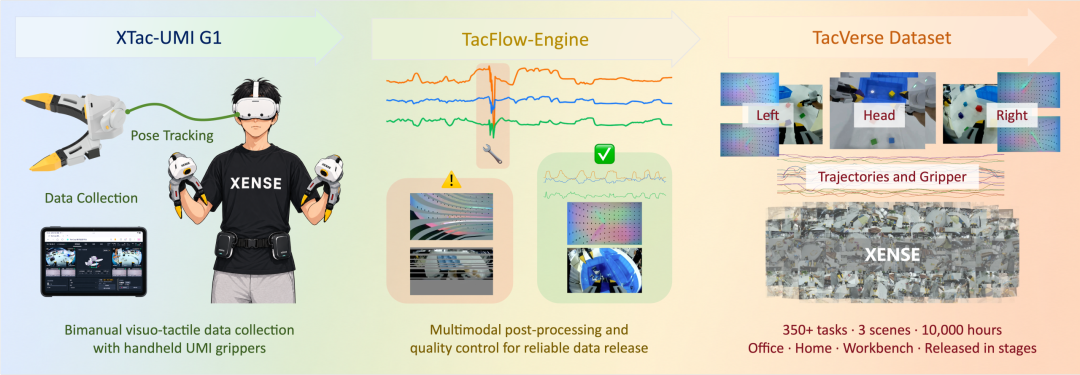
First is spatial and temporal consistency. Binocular vision, head pose, both-hand pose, and tactile information enter one collection workflow. Aligning what the operator sees, how their head moves, how their hands act, and how contact feedback changes reconstructs the full task and establishes stronger spatial and temporal relationships.
Second is inspection during collection. Operators can view visual, tactile, head-pose, and hand-pose data together on a tablet and quickly detect deviations, missing information, or task anomalies. Playback supports review of key moments and later off-site quality checks. Quality control runs throughout collection rather than relying solely on cleaning afterward.
Third is usability. The open portion of TacVerse spans offices, homes, and workbenches, with more than 120 tasks. It focuses on contact-intensive activities such as insertion, fastening, assembly, organization, and handling deformable objects. The data follows the LeRobot v3.0 standard format and can be loaded directly. Handheld collection is not tied to a particular robotic arm, making cross-platform robot learning and multimodal research easier.

Complete process information, rigorous spatial and temporal consistency, and a standard format make these data usable by models and provide real-world examples for the research, training, and evaluation of embodied models.
03. High-Precision Collection Hardware and Sensors Feed Interaction Learning
Precise sensing and rich input are important to learning interaction. The XTac UMI G1 data collection gripper used in Simate's demonstration is one terminal in Xense's data collection system, supported by a broader matrix of sensors and collection products.

High-precision sensing based on three-color-light visual-tactile technology: By reconstructing tiny deformations in a flexible contact surface with a multicolor light field, the sensor turns physical contact into multidimensional tactile information about shape, texture, and force. It delivers richer, finer sensing in a compact form and supplies models with more continuous real interaction data, improving their understanding of complex contact states.
TacSens sensor family: Xense's sensors cover flat, curved, and fingertip form factors, as well as designs for data collection devices. The company continues to improve their precision, consistency, and durability.
XTac data collection devices: Wearable products such as XTac UMI G1 capture real manipulation data for research and practical applications.
Beyond hardware, Xense has built a complete chain from tactile sensing to data collection, datasets, tactile simulation, and tactile models. Data from real settings informs simulation and model training; improved models in turn support more efficient collection, creating a continuing data flywheel.
04. Tactile Sensing Closes the Consistency Loop in 4D Physical Perception
Simate's published technical framework puts 4D physical perception at its center. A model must understand not only static spatial structures but also a physical world that changes over time. Depth, geometry, motion, occlusion, and contact must ultimately support action.
Contact is particularly difficult for vision to determine directly, yet crucial to manipulation. Tactile sensing measures contact directly, giving the 4D physical perception framework information about whether contact occurs, how firmly it is made, and whether an object slips—information that other sensing methods struggle to provide.
This joint R&D effort publicly validates Xense's data collection system in real robotic manipulation. As the collaboration develops, tactile sensing and data will have further opportunities to contribute to the 4D physical perception framework.
Conclusion
The pace of embodied AI progress will ultimately depend on the quality and efficiency of its data supply. Participating in Simate's model development gives Xense positive feedback on its approach to building a high-quality embodied data ecosystem.
Xense will continue refining every part of its sensors, collection terminals, and data pipeline. With Simate and other partners, it aims to move embodied AI from seeing the world to feeling and manipulating it reliably, providing a stronger foundation of physical-world information for next-generation research, training, and deployment.